Finding a sturdy, organized table for a 3D printer is essential for safety, efficiency, and workflow. This article highlights five top options designed to hold printers, manage filaments, and power peripheral devices. Each option prioritizes solid construction, ample storage, and convenient cable management to keep your 3D printing space clean and productive. Read on to compare features, layouts, and portability to choose the best fit for your workshop, studio, or home office.
style=”font-weight:bold;”>Summary Of Selected Products
| Product | Brand | Key Benefit | Storage Type | Portability |
|---|---|---|---|---|
| 3D Printer Table With Filaments Storage – Black | AHOWPD | Built-in power strip and ample spool storage | Two-level filament shelves | Stationary with wheels option |
| MILEFA 3D Printer Table With Filament Storage | MILEFA | Two work surfaces and up to 80 spools | Three-tier filament storage | Heavy-duty cart, some mobility |
| 3D Printer Table With Filaments Storage – Brown | AHOWPD | Same core features in Brown finish | Two-level filament storage | Stationary |
| AHOWPD 3D Printer Table With Filament Storage – Wheels | AHOWPD | Wheeled design for easy repositioning | Two-level filament storage | Wheeled cart |
| HavenlyYouth 3D Printer Stand With Filament Storage | HavenlyYouth | Large footprint with charging stations | Filament rack and bottom shelves | Stationary with potential mobility via placement |
Below are five product-focused sections. Each entry provides the key design elements, practical considerations, and how the unit can fit into different types of 3D printing workflows—from hobby setups to small workshops.
AHOWPD Black 3D Printer Table With Filament Storage

The AHOWPD 3D Printer Table with Filaments Storage is designed to consolidate printing work and filament management in one sturdy frame. The tabletop securely accommodates most standard 3D printers, while the dual filament shelves and metal tube racks keep spools organized and accessible. An integrated power strip supports two AC outlets and two USB ports, simplifying device charging and reducing cable clutter. A long power cord provides flexible placement around a workshop or studio, making it easier to power printers, Raspberry Pi controllers, and auxiliary equipment without tripping over wires. The frame emphasizes durability with a robust metal construction, aimed at long-term use in busy environments. This model emphasizes practicality for users who want an all-in-one station that reduces setup time and keeps tools, filaments, and parts within reach.
Key considerations:
– Strength and stability for larger printers
– Adequate under-shelf access for maintenance
– Cable management options and power access
– Finishes that resist workshop dust and minor spills
MILEFA Dual-Workspace Printer Table
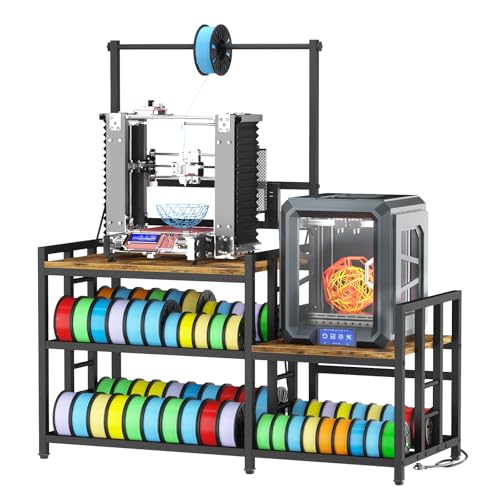
The MILEFA 3D Printer Table is engineered for efficiency with two large work surfaces and a three-tier filament storage system. The dual workstations enable running two printers simultaneously, while the bottom and middle shelves organize up to 80 spools, accommodating a broad range of filament types and sizes. This model is ideal for small studios or busy home workshops that require high throughput without sacrificing organization. The adjustable components and crossbar add versatility to handle different spool heights and printer footprints. This design streamlines production pipelines by centralizing printers, spools, and tools into a single hub.
Key considerations:
– Space planning for two printers and extensive filament storage
– Filament compatibility and shelf adjustability
– Mobility and stability when loaded with heavy spools
– Assembly complexity versus long-term benefits
AHOWPD Brown Finish Table With Filament Storage

This AHOWPD model mirrors the black variant’s functional core while offering a warm brown finish that can complement different workshop aesthetics. It features a spacious top surface for printers and a dual-level filament storage system with metal tube racks. The built-in power strip and AC outlets simplify device charging, limiting cable sprawl in busy work zones. A sturdy metal frame focuses on long-term durability, supporting heavier printers and constant use. The brown tone can blend with wood-heavy interiors while maintaining the same practical advantages as the black version.
Key considerations:
– Aesthetics and compatibility with existing workshop decor
– Load capacity and distribution across shelves
– Accessibility of filament spools during print runs
– Durability and resistance to workshop conditions
AHOWPD Wheels-Equipped 3D Printer Table

This AHOWPD model adds mobility through a wheeled cart design while preserving all the core features: a roomy top, two filament shelves, and a durable frame. The wheels enable reconfiguration of your workspace to accommodate different project stages or to free up floor space. This option is particularly useful in multi-zone setups where printers, post-processing, and testing areas shift over time. The power strip and accessible outlets support multiple devices, making it suitable for busy labs or maker spaces that frequently rearrange equipment layout.
Key considerations:
– Wheel strength and lockability for stability
– Noise and ease of movement on different floor types
– Safety features to prevent tipping when loaded
– Maintenance access for wheel assemblies
HavenlyYouth Large 3D Printer Stand With Filament Storage

The HavenlyYouth stand presents a generous footprint designed to support large 3D printers and abundant filament storage. Its top shelf accommodates sizable printers, while a dedicated filament rack and two bottom shelves offer substantial capacity for spools and accessories. The built-in charging station with two AC outlets and USB ports powers printers, computers, and peripherals without creating a tangle of cables. This model suits users who need extensive storage in a single, consolidated workstation and appreciate the added room for tools, baskets, or lights to improve visibility during print operations.
Key considerations:
– Suitability for very large printers and high spool counts
– Cable management in a large workstation
– Stability with heavy loads and potential vibration
– Ease of cleaning and maintenance in a busy workshop
Buying Guide: Key Purchase Considerations And Comparisons
When choosing a dedicated 3D printer table, factor in printer size, intended workflow, and existing workspace layout. Important considerations include:
- Printer footprint and clearance: Ensure the top surface can accommodate your printer with room to spare for maintenance access and cooling.
- Filament storage capacity: Assess how many spools you typically use and choose a model with adequate shelf depth, width, and vertical stacking to minimize reorganization.
- Power and data needs: A built-in power strip and multiple USB ports simplify connections to printers, cameras, and control devices; verify cord length fits your space.
- Stability and durability: Look for steel frames or reinforced panels, especially for heavy printers or high-use environments where vibration can affect print quality.
- Mobility vs. stationary design: Wheels offer flexibility in dynamic spaces, but fixed tables typically offer greater stability and lower risk of tipping.
- Cable management: Integrated grommets, clips, or cable trays help maintain a clean work area and reduce hazards during printing operations.
- Future scalability: Consider modular or adjustable shelves if you anticipate changing printer sizes or filament needs.
- Workspace ergonomics: Height adjustability and shelf configurations influence comfortable access to spools, controls, and tools during long print sessions.
In practice, users with multiple printers or extensive filament libraries may prioritize models with dual work surfaces and larger filament storage, like the MILEFA table, or opt for wheel-equipped carts for flexible studio layouts. For those who value aesthetics alongside function, finish options such as brown and black can harmonize with different workshop designs without compromising performance. Overall, a quality 3D printer table should balance stability, storage, and accessibility to support smooth printing operations and organized, efficient workflows.